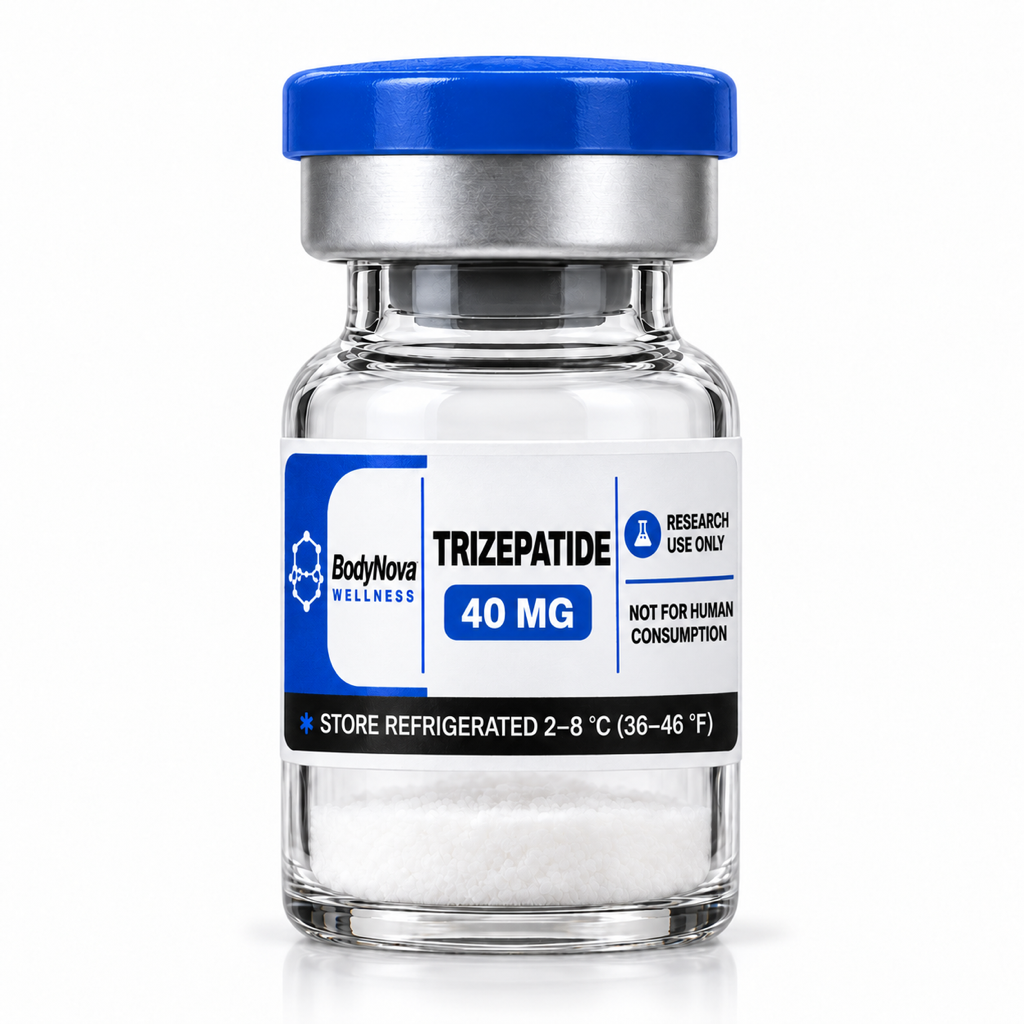
Tirzepatide
Not for human consumption
Tirzepatide
A dual GIP and GLP-1 receptor agonist studied in metabolic research.
$95 USD per vial
Also known as: Tirzepatide, Trizepatide, T1XZ, GIP/GLP-1 dual agonist
Overview
Tirzepatide is described in the literature as a single synthetic peptide, modified with a fatty-diacid side chain, that acts as an agonist at two receptors: GIP and GLP-1. It is studied in metabolic-regulation, glucose-metabolism, energy-balance, and body-composition research, where its dual-receptor activity is compared with that of single-receptor agonists. Published findings come from laboratory models and from clinical studies, and how they carry over between models and settings is still being examined. It is offered here for research use only.
Research highlights
- Examined in cell and primary-islet signaling studies, where stronger GIP receptor engagement and biased signaling at the GLP-1 receptor were reported.1Cell
- Studied in obese mice for insulin sensitivity, with GIP receptor involvement examined in mice lacking the GLP-1 receptor.2Animal
- Investigated in human adipocyte and mouse models, linking long-acting GIP receptor activation to insulin signaling, glucose uptake and lipolysis.3Animal
- Investigated in a randomized, placebo- and active-controlled phase 2 trial of adults with type 2 diabetes for glycemic markers and body weight.4Human
- Investigated in a randomized, placebo-controlled trial of adults with overweight or obesity after a lifestyle program, for percent change in body weight.5Human
- Compared with a single-receptor agonist in an open-label randomized trial of adults with obesity, with percent change in body weight as primary end point.6Human
How it works in research
Tirzepatide is described in the literature as a single synthetic peptide that acts as an agonist at two receptors, GIP and GLP-1. Signaling studies in cells report greater engagement of the GIP receptor than of the GLP-1 receptor, with biased signaling at the GLP-1 receptor that favors cAMP generation over β-arrestin recruitment. Studies in obese mice and in human adipocytes examine how long-acting GIP receptor activation relates to insulin sensitivity and to nutrient handling in adipose tissue. These mechanisms are proposed from laboratory work, and how they carry over to human settings is still being examined.
Published research
This product is sold for laboratory research use only and is not approved for human use.
Research summary updated Oct 2026
Related peptides
- BodyNovaWellness
MOTS-c
20 MGResearch use only
Not for human consumptionSTORE REFRIGERATED 2–8 °C (36–46 °F)$60 USD per vial
A mitochondrial-derived peptide studied in metabolic and exercise research.
- BodyNovaWellness
Tesamorelin
20 MGResearch use only
Not for human consumptionSTORE REFRIGERATED 2–8 °C (36–46 °F)$100 USD per vial
A GHRH analog studied in metabolic and body-composition research.
- BodyNovaWellness
Retatrutide
30 MGResearch use only
Not for human consumptionSTORE REFRIGERATED 2–8 °C (36–46 °F)$100 USD per vial
An investigational triple-receptor agonist studied in metabolic and body-composition research.
- BodyNovaWellness
5-Amino-1MQ
10 MGResearch use only
Not for human consumptionSTORE REFRIGERATED 2–8 °C (36–46 °F)$45 USD per vial
A small-molecule NNMT inhibitor studied in metabolic research.
- BodyNovaWellness
MOTS-c
40 MGResearch use only
Not for human consumptionSTORE REFRIGERATED 2–8 °C (36–46 °F)$100 USD per vial
A mitochondrial-derived peptide studied in metabolic and exercise research.