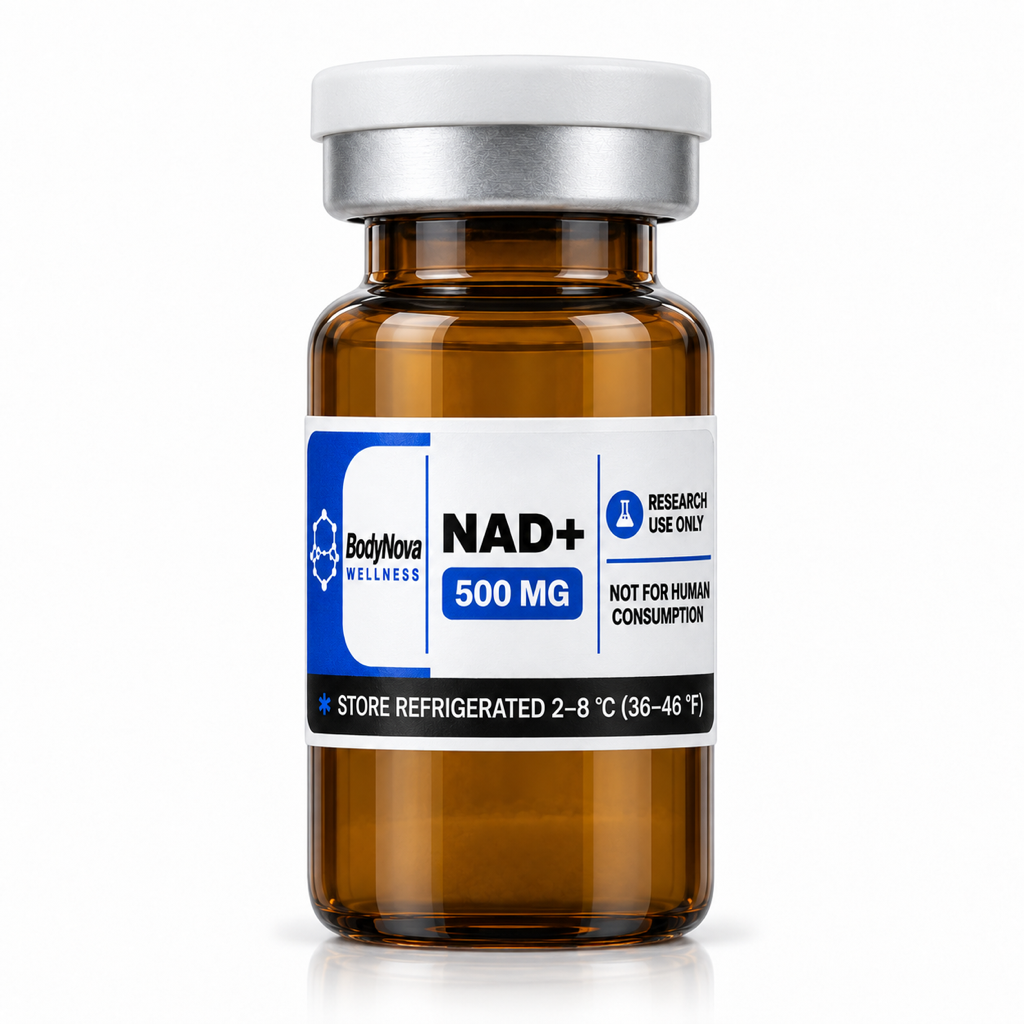
NAD+
Not for human consumption
NAD+
A cellular coenzyme studied in energy-metabolism and cellular-aging research.
$45 USD per vial
Also known as: NAD+, Nicotinamide adenine dinucleotide, β-NAD
Overview
NAD+ is not technically a peptide but a nucleotide-derived coenzyme found in every cell, where it cycles between its oxidized form (NAD+) and reduced form (NADH) to carry electrons in redox reactions. It acts as a substrate and cofactor for enzyme families such as the sirtuins, PARP enzymes, and CD38, which is why it is studied in mitochondrial energy-metabolism, DNA-repair, and cell-signaling research. Tissue NAD+ levels are reported to decline with age and metabolic stress in some models, though the degree and biological meaning vary by tissue. Most of the current evidence is preclinical or drawn from small human studies of NAD+ and its precursors (NMN and NR), and it remains an active area of research. It is offered here for research use only.
Research highlights
- A nucleotide-derived coenzyme rather than a peptide
- Cycles between oxidized (NAD+) and reduced (NADH) forms to carry electrons in redox reactions
- Studied for its role as a substrate and cofactor for sirtuins, PARP enzymes, and CD38
- Investigated in models of mitochondrial energy metabolism
- Explored in DNA-repair and cell-signaling research
- Reported to decline with age and metabolic stress in some models