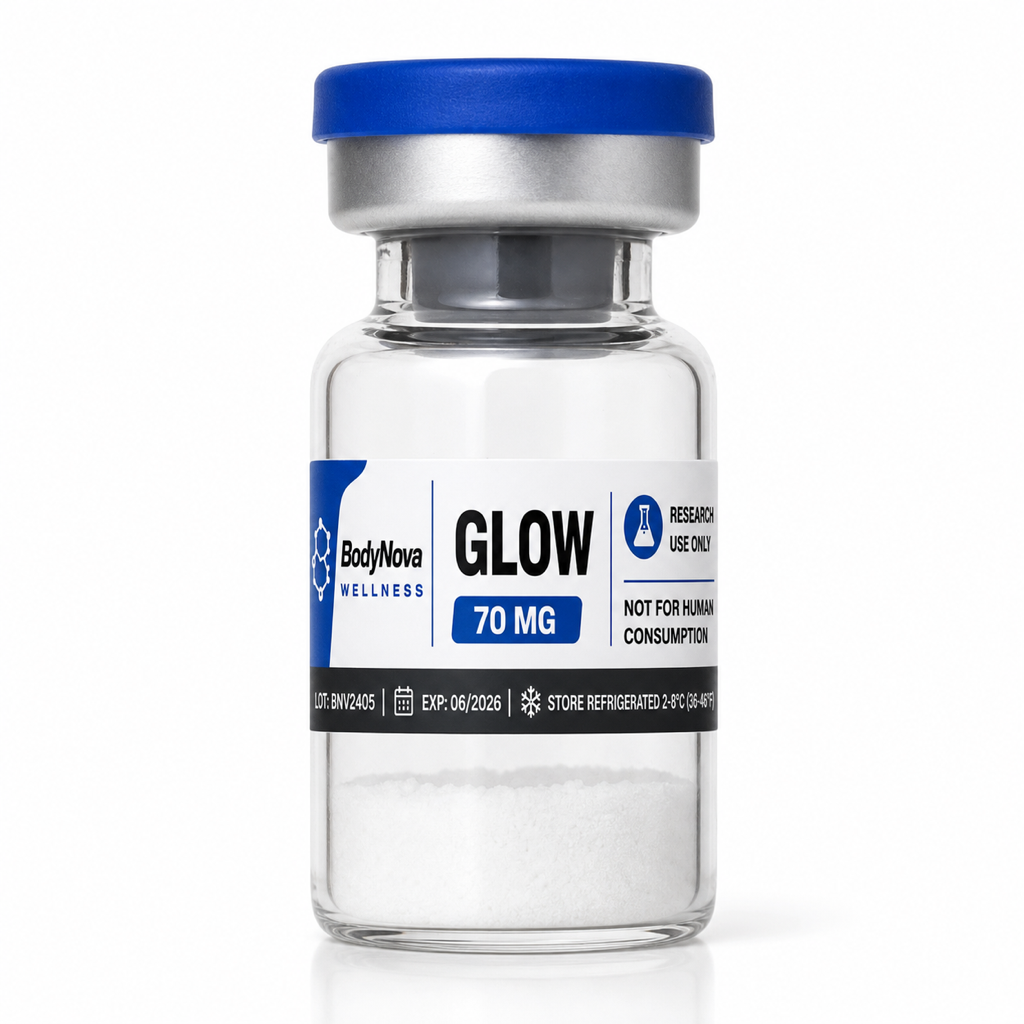
GLOW
Not for human consumption
GLOW
A copper-peptide blend studied in skin and tissue-repair research.
$70 USD per vial
Also known as: GLOW Blend
Overview
GLOW combines three peptides that appear frequently in the skin, hair, and connective-tissue literature. It is offered as a research-use-only preparation for laboratory work. The composition shown is a common definition and is being confirmed with the supplier.
Research covers each component separately; this combination has not been studied as a blend.
GHK-Cu
Human studies
Research highlights
- Examined in fibroblast cultures, where increased collagen synthesis was reported, independent of any change in cell number.1Cell
- Studied in a rat wound-chamber model, where higher collagen, glycosaminoglycan and total protein content was reported in the wound tissue.2Animal
- Investigated in a rat model of ischemic open wounds, with smaller wound areas and lower TNF-alpha and matrix metalloproteinase levels reported.3Animal
- Explored in cultured human dermal fibroblasts, including irradiated cells, for growth rate and production of basic FGF and VEGF.4Cell
- Tested in an irradiated rat skin-flap model, where no difference in flap ischemia, vessel number or VEGF expression was found versus controls.5Animal
- A small randomized trial of CO2 laser-resurfaced skin found no objective difference between groups, with higher patient-reported skin quality.6Human
How it works in research
GHK-Cu is described in the literature as the copper(II) complex of glycyl-L-histidyl-L-lysine, a tripeptide isolated from human plasma. Cell studies report increased collagen synthesis and altered growth-factor production in dermal fibroblasts, and authors have proposed that the tripeptide may be released from type I collagen by proteases at a wound site. In rat wound models its effects on extracellular-matrix content, inflammatory mediators and matrix metalloproteinases have been examined, with mixed results across models. Human data are limited, and the mechanisms remain proposals from laboratory and animal work.
Published research
- Effects of topical copper tripeptide complex on wound healing in an irradiated rat model. (PubMed, opens in a new tab)Otolaryngol Head Neck Surg, 2013Animal
- Effects of topical copper tripeptide complex on CO2 laser-resurfaced skin. (PubMed, opens in a new tab)Arch Facial Plast Surg, 2006Human
BPC-157
Human studies
Research highlights
- Studied in a rat model of Achilles tendon-to-bone transection, compared with a corticosteroid, for early functional recovery, inflammation and new vessels.1Animal
- Examined in cultured rat tendon fibroblasts for outgrowth, survival under stress and migration, with the FAK-paxillin pathway implicated.2Cell
- Investigated in a rat model of gastrocnemius muscle injury, alone and with a corticosteroid, for functional, macroscopic and histological healing.3Animal
- Examined in rat muscle and tendon injury models for VEGF expression and angiogenesis markers; cultured cells showed no direct angiogenic effect.4Animal
- Examined alone and with TB-500 in a 2026 rat Achilles repair study; the combination showed no added benefit over either peptide alone.5Animal
- Human data are very limited: a 2026 systematic review found three small studies without control groups (30 people) and rated certainty very low.6Human
How it works in research
BPC-157 is described in the literature as a synthetic pentadecapeptide, a 15-amino-acid partial sequence of a protein reported in human gastric juice. In cultured rat tendon fibroblasts it has been reported to increase outgrowth, survival under stress and migration, with activation of the FAK-paxillin pathway examined as a possible mechanism. In rat muscle and tendon injury models, VEGF expression and markers of angiogenesis have been examined, while cell cultures in the same work showed no direct angiogenic effect. These mechanisms are proposed from animal and cell work, and human evidence is very limited and of low quality.
Published research
TB-500
Human studies
Research highlights
- Thymosin β4 and a seven-residue actin-binding peptide were examined in dermal wound models in diabetic and aged mice.1Animal
- TB-500 itself was examined in a 2026 rat Achilles tendon repair study with biomechanical and histological measures, alone and with BPC-157.2Animal
- Thymosin β4 rose in plasma during exercise in people; in mice it was reported not to ameliorate metabolic disruption or enhance muscle regeneration.3Human
- Studied in mouse muscle regeneration, where thymosin β4 expression rose after injury, and in myoblast cultures for chemotaxis.4Animal
- Investigated in endothelial cell cultures for migration and tube formation, including mutants lacking Ac-SDKP or the actin-binding sequence.5Cell
- Human data concern thymosin β4, not TB-500: a Phase II dry-eye trial missed its primary endpoints but differed on some secondary ones.6Human
How it works in research
TB-500 is variously described in the literature as a synthetic peptide related to thymosin β4 (Tβ4), a protein that binds actin. Most of the research cited here was done on thymosin β4 itself and on related fragments rather than on TB-500, apart from one 2026 rat study that examined TB-500 by name. Laboratory and animal work reports effects on cell migration, including endothelial migration, tube formation and myoblast chemotaxis, with the actin-binding sequence and the N-terminal Ac-SDKP tetrapeptide examined as possible contributors. These mechanisms come from animal and cell work, and their relevance to TB-500 in humans has not been established.
Published research
- Discovery of thymosin β4 as a human exerkine and growth factor. (PubMed, opens in a new tab)Am J Physiol Cell Physiol, 2021Human
This product is sold for laboratory research use only and is not approved for human use.
Research summary updated Oct 2026
Related peptides
- BodyNovaWellness
KLOW
80 MG(GHK-Cu + BPC-157 + TB-500 + KPV)Research use only
Not for human consumptionSTORE REFRIGERATED 2–8 °C (36–46 °F)$80 USD per vial
GLOW's copper-peptide blend extended with KPV, studied in repair and inflammation research.
- BodyNovaWellness
AHK-Cu
50 MGResearch use only
Not for human consumptionSTORE REFRIGERATED 2–8 °C (36–46 °F)$35 USD per vial
A copper tripeptide studied in hair and skin research.