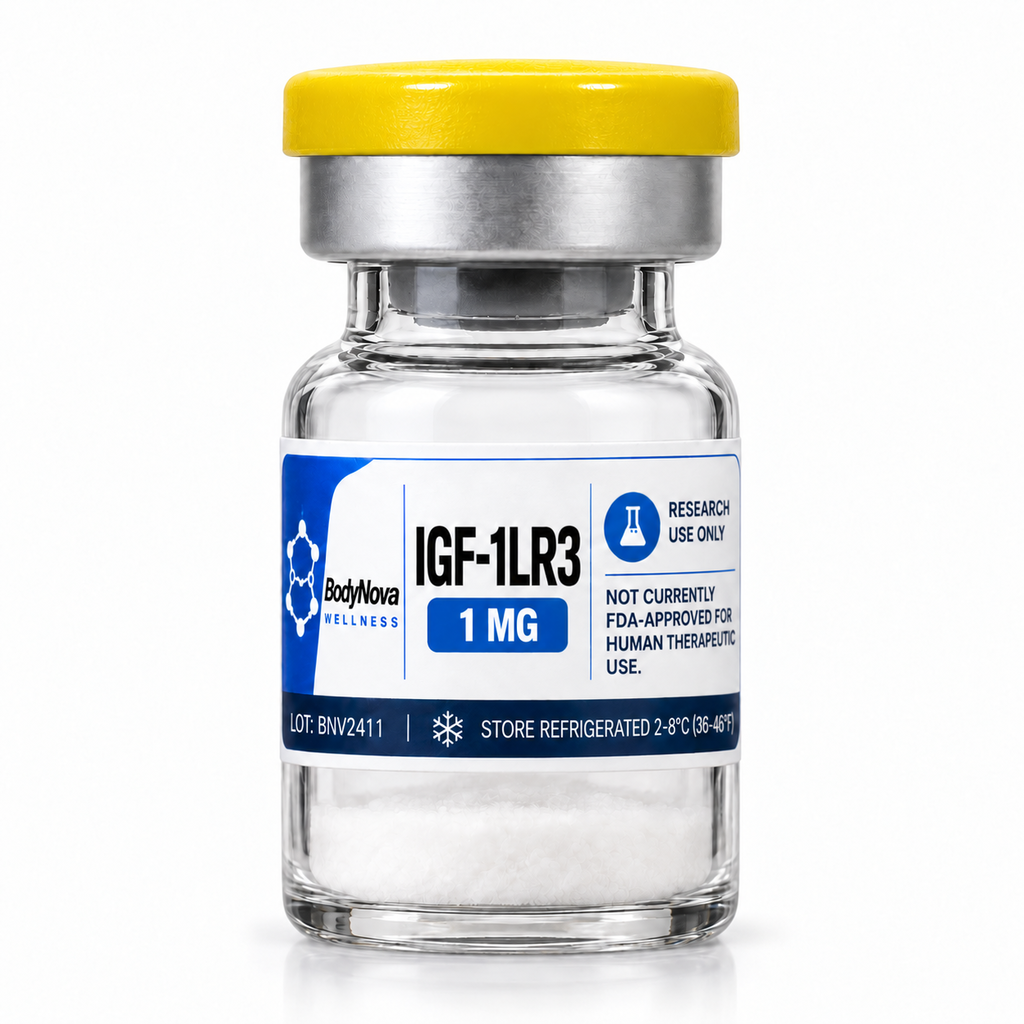
IGF-1 LR3
Not for human consumption
IGF-1 LR3
A long-acting IGF-1 analog studied in muscle-growth and protein-synthesis research.
$65 USD per vial
Also known as: IGF-1 LR3, Long R3 IGF-1, Insulin-like growth factor 1 LR3
Overview
IGF-1 LR3 (Long R3 IGF-I) is a synthetic analog of insulin-like growth factor 1, described in the literature as an 83-amino-acid analog carrying an N-terminal 13-residue extension and an arginine-for-glutamic-acid substitution at position 3. Those changes give it reduced affinity for the IGF-binding proteins and therefore a longer active life in research models than native IGF-1. It is studied in muscle-growth, protein-synthesis, tissue-repair, and cell-signaling research, where its activity is attributed to the IGF-1 receptor, cross-talk with the insulin receptor, and the downstream PI3K-Akt and MAPK pathways. It has also been examined in glucose-related and body-composition research. Human evidence remains limited and mixed, and the only FDA-approved IGF-1 therapy (mecasermin) is a different molecule cleared solely for specific pediatric growth-failure indications, not for general therapeutic use. It is offered here for research use only.
Research highlights
- Studied in growing female rats for body weight gain, nitrogen retention and muscle protein synthesis; it was reported as more potent than native IGF-I.1Animal
- Examined in beef heifers on restricted feed for whole-body and muscle protein metabolism, with plasma amino acids and glucose also measured.2Animal
- Used in L6 muscle-cell cultures to stimulate proliferation and differentiation, with the influence of IGFBP-3 on each effect compared.3Cell
- Examined in cell culture for IGF-1 receptor signaling, with analog-induced receptor phosphorylation assessed in the presence of IGFBP-3.4Cell
- Growth results in large animals are mixed: lower growth and GH in finisher pigs, and no growth difference in growth-restricted fetal sheep.5,6Animal
How it works in research
IGF-1 LR3 (Long R3 IGF-I) is described in the literature as a synthetic analog of IGF-I with an amino-terminal extension and an arginine-for-glutamate substitution at position 3, which give it very weak binding to IGF-binding proteins while it retains the ability to bind the type I IGF receptor. Cell studies have used it to examine receptor signaling and the proliferation and differentiation of muscle cells, and animal studies have examined growth, nitrogen and protein metabolism, and insulin- and glucose-related measures. Results across species have been mixed, and no human study is cited here.
Published research
- Action of long(R3)-insulin-like growth factor-1 on protein metabolism in beef heifers. (PubMed, opens in a new tab)Domest Anim Endocrinol, 1999Animal
- IGF-1 LR3 does not promote growth in late-gestation growth-restricted fetal sheep. (PubMed, opens in a new tab)Am J Physiol Endocrinol Metab, 2025Animal
This product is sold for laboratory research use only and is not approved for human use.
Research summary updated Oct 2026
Related peptides
- BodyNovaWellness
CJC-1295 + Ipamorelin
10 MG(CJC-1295 (5 mg) + Ipamorelin (5 mg))Research use only
Not for human consumptionSTORE REFRIGERATED 2–8 °C (36–46 °F)$60 USD per vial
A GHRH and GHRP peptide pairing studied in growth-hormone research.
- BodyNovaWellness
Ipamorelin
10 MGResearch use only
Not for human consumptionSTORE REFRIGERATED 2–8 °C (36–46 °F)$30 USD per vial
A selective growth-hormone secretagogue studied in growth-hormone-axis research.