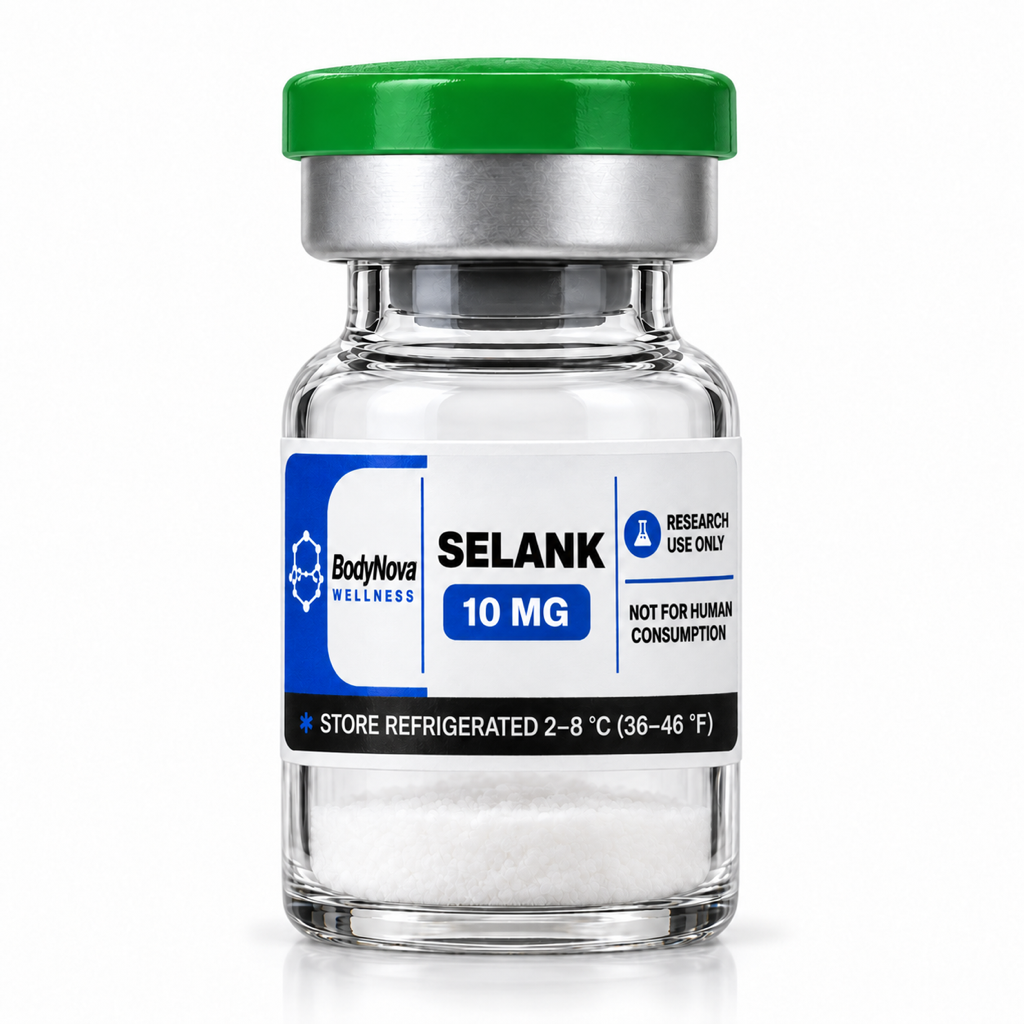
Selank
Not for human consumption
Selank
A synthetic peptide studied in anxiety and mood research.
$40 USD per vial
Also known as: Selank, Tuftsin analog
Overview
Selank is a synthetic peptide related to tuftsin, investigated for its role in anxiety, mood, and mental-clarity research. It is offered here for research use only.
Research highlights
- Studied in a rat model of toxin-induced dopamine-neuron loss, alongside Semax; anxiety on an elevated maze was reported lower with Selank.1Animal
- Examined in mouse spleen for expression of 84 inflammation-related genes; changes were reported in 34 of them, including Bcl6.2Animal
- In cultured neuroblastoma cells, Selank alone changed no GABAergic gene mRNA levels but altered the responses to GABA and to olanzapine.3Cell
- In rat hippocampal slices, Selank was reported to raise the amplitude and rate of spontaneous inhibitory synaptic currents in CA1 neurons.4Cell
- Examined in adult rats given a catecholamine-damaging neurotoxin in the first days of life, for learning, memory and attention to sensory stimuli.5Animal
- Human data are limited; one placebo-controlled resting-state fMRI study of 52 healthy participants, alongside Semax, examined amygdala connectivity.6Human
How it works in research
Selank is described in the literature as a synthetic heptapeptide (Thr-Lys-Pro-Arg-Pro-Gly-Pro) built on tuftsin, an endogenous immunomodulatory peptide. Some reports compare its effects with those of benzodiazepines, so laboratory work has examined whether it modulates the GABAergic system: recordings of inhibitory synaptic currents in rat hippocampal slices point to possible effects on inhibitory signaling, while one neuroblastoma-cell study found no direct change in GABAergic gene expression. Given its origin in tuftsin, expression of inflammation-related genes has also been examined in mouse spleen. Studies in rats have also looked at behavior in a dopamine-neuron lesion model and at learning, memory and attention after neurotoxin damage in early life. Most of the literature comes from a small number of Russian research groups and from animal and cell models, and human data are limited.
Published research
This product is sold for laboratory research use only and is not approved for human use.
Research summary updated Oct 2026