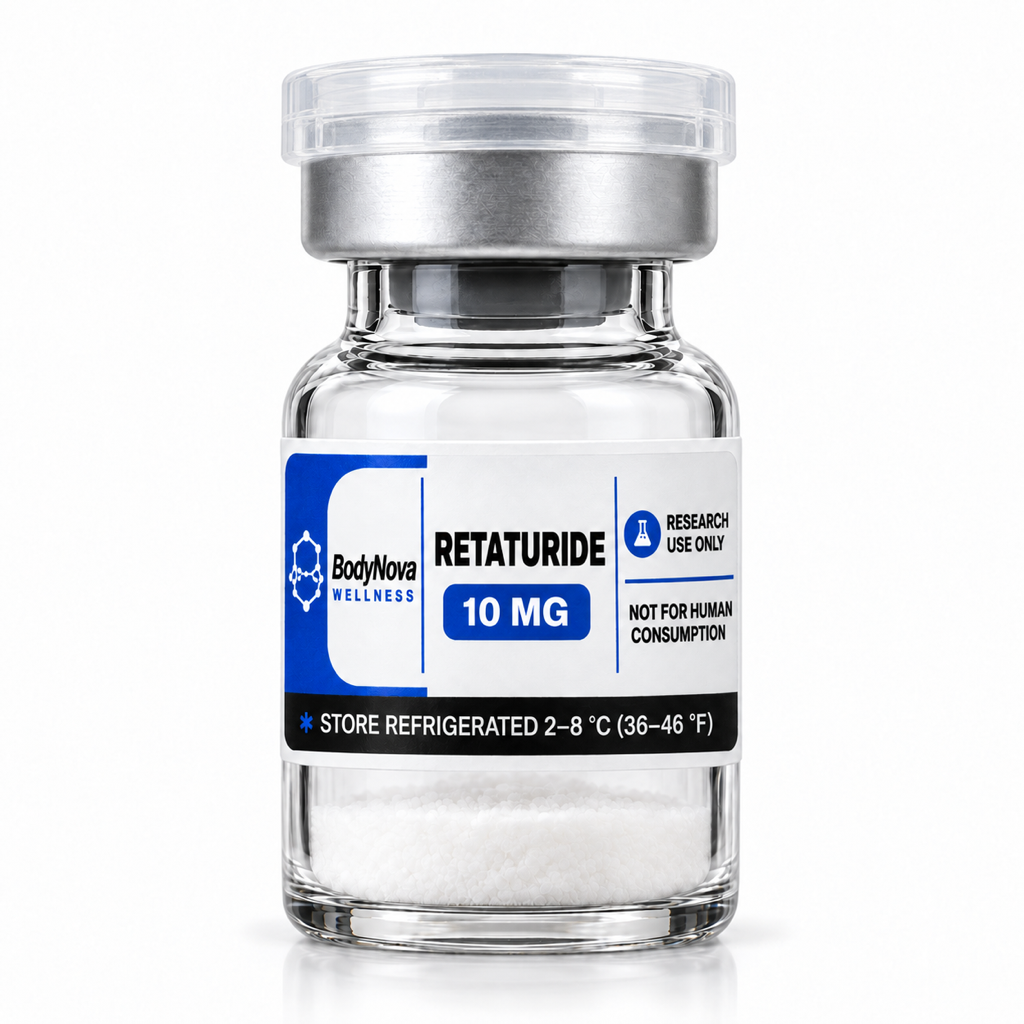
Retatrutide
Not for human consumption
Retatrutide
An investigational triple-receptor agonist studied in metabolic and body-composition research.
$100 USD per vial
Also known as: Retatrutide, LY3437943, GIP/GLP-1/glucagon triple agonist, Retaturide
Overview
Retatrutide (LY3437943) is an investigational compound: it has not been approved by the FDA or any other regulatory agency for any use, and it remains in clinical development. It is described in the literature as a single 39-amino-acid peptide, modified with a fatty-acid side chain, that acts as an agonist at three receptors: GIP, GLP-1, and glucagon. It is studied in metabolic-regulation, energy-balance, and body-composition research, where its combined activity at the three receptors is compared with that of single- and dual-receptor agonists. The published findings come from preclinical models and from clinical trials that are still under way, so longer-term data remain incomplete. It is offered here for research use only.
Research highlights
- Examined in isolated mouse atria, where glucagon-receptor signaling through cAMP and PKA was proposed to underlie effects on beating rate.1Animal
- Studied in diet-induced obese mouse and hamster models for body composition, food intake and hepatic triglyceride content.2Animal
- Investigated in a phase 2 randomized trial of adults with obesity for changes in body weight, with safety also assessed.3Human
- Investigated in a phase 2 trial in adults with type 2 diabetes, with placebo and single-receptor comparators, for glycemic markers and body weight.4Human
- Examined in a randomized phase 2a substudy of adults with fatty liver disease for relative change in liver fat content.5Human
- Investigated in a phase 3 randomized trial of adults with obesity for body weight, with knee osteoarthritis and sleep apnea subgroups also examined.6Human
How it works in research
Retatrutide (LY3437943) is described in the literature as a single peptide that acts as an agonist at three receptors: GIP, GLP-1 and glucagon. Preclinical work examines it in isolated mouse atrial tissue, where a glucagon-receptor pathway through cAMP and PKA has been proposed, and in mouse and hamster models of diet-induced obesity. Randomized clinical trials in adults with obesity, type 2 diabetes or fatty liver disease have investigated body weight, glycemic markers and liver fat. It remains an investigational compound, and longer-term data are still being collected.
Published research
- Contractile effects of retatrutide in isolated mouse atrial preparations. (PubMed, opens in a new tab)Naunyn Schmiedebergs Arch Pharmacol, 2025Animal
- Retatrutide Shows Multiple Metabolic Benefits in Diet-Induced Obese MASH Mouse and Hamster Models. (PubMed, opens in a new tab)Obesity (Silver Spring), 2026Animal
This product is sold for laboratory research use only and is not approved for human use.
Research summary updated Oct 2026
Related peptides
- BodyNovaWellness
MOTS-c
20 MGResearch use only
Not for human consumptionSTORE REFRIGERATED 2–8 °C (36–46 °F)$60 USD per vial
A mitochondrial-derived peptide studied in metabolic and exercise research.
- BodyNovaWellness
Tesamorelin
20 MGResearch use only
Not for human consumptionSTORE REFRIGERATED 2–8 °C (36–46 °F)$100 USD per vial
A GHRH analog studied in metabolic and body-composition research.
- BodyNovaWellness
Tirzepatide
40 MGResearch use only
Not for human consumptionSTORE REFRIGERATED 2–8 °C (36–46 °F)$95 USD per vial
A dual GIP and GLP-1 receptor agonist studied in metabolic research.
- BodyNovaWellness
5-Amino-1MQ
10 MGResearch use only
Not for human consumptionSTORE REFRIGERATED 2–8 °C (36–46 °F)$45 USD per vial
A small-molecule NNMT inhibitor studied in metabolic research.
- BodyNovaWellness
MOTS-c
40 MGResearch use only
Not for human consumptionSTORE REFRIGERATED 2–8 °C (36–46 °F)$100 USD per vial
A mitochondrial-derived peptide studied in metabolic and exercise research.