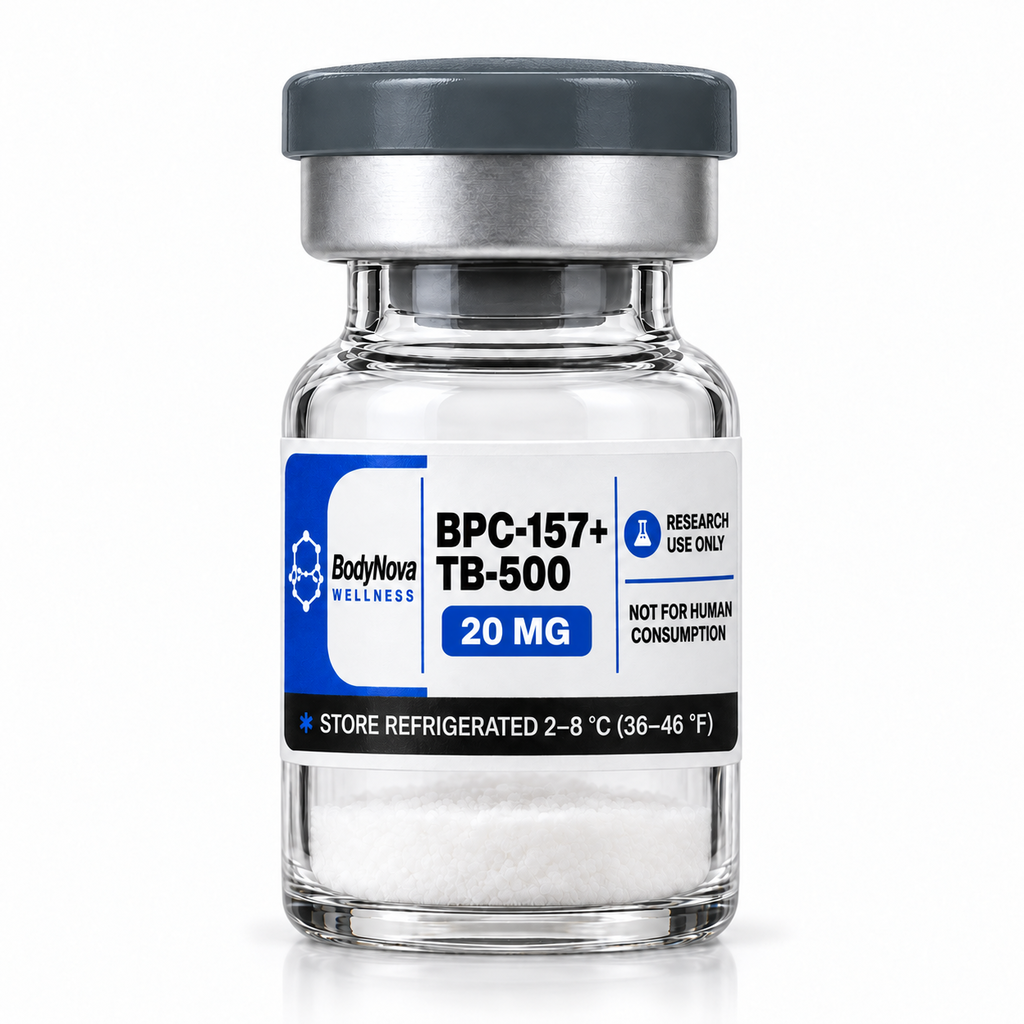
BPC-157 + TB-500
Not for human consumption
BPC-157 + TB-500
A BPC-157 and TB-500 pairing studied in tissue-repair and recovery research.
$65 USD per vial
Also known as: BPC-157 + TB-500, Wolverine Blend, Body Protection Compound 157 + Thymosin beta-4 fragment
Overview
This blend pairs BPC-157 with TB-500, two peptides frequently studied together as a tissue-recovery combination. BPC-157 is a synthetic 15-amino-acid pentadecapeptide derived from a protective protein found in gastric juice; its research is mostly preclinical, drawn from animal and laboratory models of tendon and ligament recovery, muscle and tissue repair, inflammation, wound healing, and recovery from exercise-related injury, with no adequate controlled human trials to date. TB-500 is a synthetic fragment related to thymosin beta-4, corresponding to its actin-binding domain, and is studied mainly in laboratory and animal models of wound healing, tissue repair, muscle recovery, tendon and ligament recovery, and the processes involved in blood-vessel formation (angiogenesis) and tissue remodeling; its human clinical evidence is very limited. Together the two are commonly examined as a tissue-recovery pairing for muscle, tendon, and ligament models, and the available evidence remains preclinical. It is offered here for research use only.
Research highlights
- Pairs two peptides commonly studied together for tissue recovery
- BPC-157 is a synthetic 15-amino-acid pentadecapeptide derived from a protein found in gastric juice
- TB-500 is a synthetic fragment related to thymosin beta-4, corresponding to its actin-binding domain
- Studied in models of tendon, ligament, and muscle recovery
- Investigated in models of tissue repair, inflammation, and wound healing
- TB-500 explored in angiogenesis and tissue-remodeling research, with evidence that remains preclinical