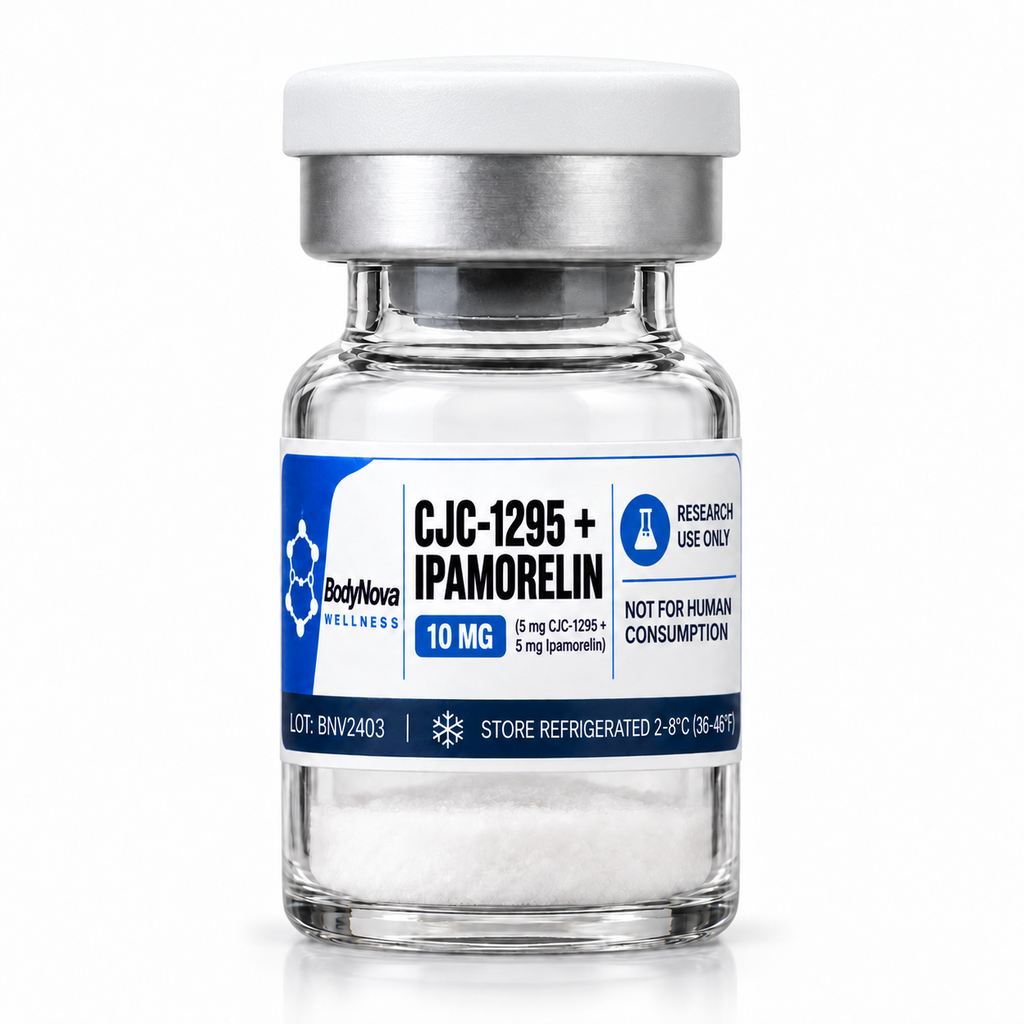
CJC-1295 + Ipamorelin
Not for human consumption
CJC-1295 + Ipamorelin
A GHRH and GHRP peptide pairing studied in growth-hormone research.
$60 USD per vial
Also known as: CJC-1295 / Ipamorelin, GHRH + GHRP blend
Overview
This preparation pairs CJC-1295 with Ipamorelin, two peptides frequently studied together in growth-hormone-axis research. It is offered as a research-use-only combination for laboratory work.
Research covers each component separately; this combination has not been studied as a blend.
CJC-1295
Human studies
Research highlights
- Characterized in rats as an albumin-binding GHRH(1-29) analog; GH release was measured in cultured pituitary cells and in plasma.1Animal
- Examined in two randomized, placebo-controlled trials in healthy adults for pharmacokinetics, GH and IGF-I concentrations and safety.2Human
- Studied in healthy men for GH pulsatility, where trough GH levels were reported to rise while the pulses themselves were preserved.3Human
- A serum proteomic analysis in healthy men reported protein changes, including an apolipoprotein A1 isoform, as candidate markers of GH activity.4Human
- Human data come from short studies in healthy adults; effects in other populations have not been established.2,3Human
How it works in research
CJC-1295 is described in the literature as a synthetic analog of GHRH(1-29), modified with a reactive group so that it binds serum albumin, which extends its time in circulation. In rats it was reported to stimulate growth hormone release from cultured pituitary cells and in vivo, and to stay detectable in plasma for days. In healthy adults it has been examined for its effects on growth hormone, IGF-I and growth hormone pulsatility. These findings come from short studies in healthy volunteers and from animal work; its effects in other settings have not been established.
Published research
Ipamorelin
Human studies
Research highlights
- Characterized in rat pituitary cells, rats and swine as a selective GH releaser; ACTH and cortisol in swine resembled GHRH stimulation.1Animal
- Examined in healthy male volunteers for pharmacokinetics and GH response, with a short half-life and a single episode of GH release described.2Human
- Studied in adult female rats for bone mineral content and longitudinal bone growth, with body weight also monitored.4,3Animal
- Investigated in a rat model of postoperative ileus for colonic transit time, fecal output, food intake and body weight.5Animal
- Evaluated in a phase 2 randomized, placebo-controlled study of adults after bowel resection; no significant efficacy differences were reported.6Human
How it works in research
Ipamorelin is described in the literature as a synthetic pentapeptide that stimulates growth hormone release through a GHRP-like receptor of the ghrelin type. In rat pituitary cells, rats and swine it was reported to release growth hormone, with ACTH and cortisol levels in swine similar to those after GHRH stimulation. Animal studies have also examined bone, body weight and gastrointestinal transit, and a small number of human studies have looked at its pharmacokinetics and at postoperative ileus. The evidence is mostly preclinical.
Published research
- Ipamorelin, the first selective growth hormone secretagogue. (PubMed, opens in a new tab)Eur J Endocrinol, 1998Animal
- Ipamorelin, a new growth-hormone-releasing peptide, induces longitudinal bone growth in rats. (PubMed, opens in a new tab)Growth Horm IGF Res, 1999Animal
- Efficacy of ipamorelin, a novel ghrelin mimetic, in a rodent model of postoperative ileus. (PubMed, opens in a new tab)J Pharmacol Exp Ther, 2009Animal
This product is sold for laboratory research use only and is not approved for human use.
Research summary updated Oct 2026
Related peptides
- BodyNovaWellness
IGF-1 LR3
1 MGResearch use only
Not for human consumptionSTORE REFRIGERATED 2–8 °C (36–46 °F)$65 USD per vial
A long-acting IGF-1 analog studied in muscle-growth and protein-synthesis research.
- BodyNovaWellness
Ipamorelin
10 MGResearch use only
Not for human consumptionSTORE REFRIGERATED 2–8 °C (36–46 °F)$30 USD per vial
A selective growth-hormone secretagogue studied in growth-hormone-axis research.