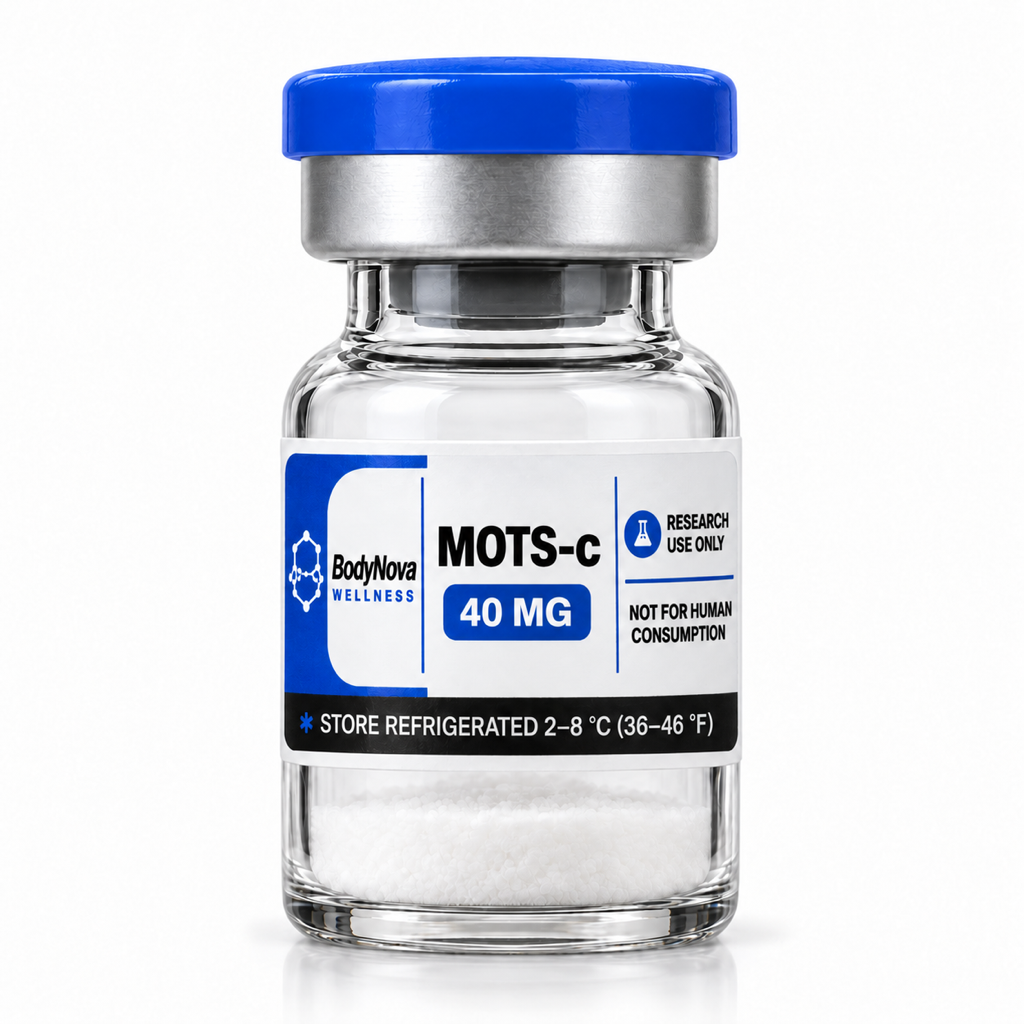
MOTS-c
Not for human consumption
MOTS-c
A mitochondrial-derived peptide studied in metabolic and exercise research.
$100 USD per vial
Also known as: MOTSc, Mitochondrial-derived peptide
Overview
MOTS-c is a mitochondrial-derived peptide investigated for its role in cellular energy metabolism. It is studied in models of metabolic regulation and physical performance and is offered here for research use only.
Research highlights
- Examined in cultured cells: MOTS-c was reported to raise OPA1 and MFN2, and blocking these fusion proteins abrogated GLUT4 translocation and glucose uptake.1Cell
- Explored in cultured cells, where movement into the nucleus and AMPK-dependent changes in gene expression were reported under glucose restriction.2Cell
- Investigated in young, middle-aged and old mice for physical performance and skeletal muscle metabolism.3Animal
- Examined in pancreatic alpha- and beta-cell lines for effects on insulin and glucagon secretion, cell viability and apoptosis.4Cell
- Human data are observational: plasma MOTS-c was measured in adults without diabetes and examined alongside waist circumference, android fat and liver fat.5Human
- Circulating MOTS-c was measured in a randomized exercise study and showed only a trend to rise after acute endurance exercise.6Human
How it works in research
MOTS-c is described in the literature as a 16-amino-acid peptide encoded within the mitochondrial 12S rRNA gene. In cultured cells it has been linked to movement into the nucleus under metabolic stress, where it is reported to influence gene expression in an AMPK-dependent manner, and to mitochondrial fusion proteins and GLUT4 translocation. A study in mice of different ages examined physical performance and skeletal muscle metabolism. Human data come from observational and exercise-physiology studies of circulating MOTS-c levels, and the mechanisms proposed from laboratory work have not been established in people.
Published research
- MOTS-c regulates pancreatic alpha and beta cell functions in vitro. (PubMed, opens in a new tab)Histochem Cell Biol, 2024Cell
- Plasma mitochondrial derived peptides MOTS-c and SHLP2 positively associate with android and liver fat in people without diabetes. (PubMed, opens in a new tab)Biochim Biophys Acta Gen Subj, 2021Human
- Acute endurance exercise stimulates circulating levels of mitochondrial-derived peptides in humans. (PubMed, opens in a new tab)J Appl Physiol (1985), 2021Human
This product is sold for laboratory research use only and is not approved for human use.
Research summary updated Oct 2026
Related peptides
- BodyNovaWellness
MOTS-c
20 MGResearch use only
Not for human consumptionSTORE REFRIGERATED 2–8 °C (36–46 °F)$60 USD per vial
A mitochondrial-derived peptide studied in metabolic and exercise research.
- BodyNovaWellness
Tesamorelin
20 MGResearch use only
Not for human consumptionSTORE REFRIGERATED 2–8 °C (36–46 °F)$100 USD per vial
A GHRH analog studied in metabolic and body-composition research.
- BodyNovaWellness
Retatrutide
30 MGResearch use only
Not for human consumptionSTORE REFRIGERATED 2–8 °C (36–46 °F)$100 USD per vial
An investigational triple-receptor agonist studied in metabolic and body-composition research.
- BodyNovaWellness
Tirzepatide
40 MGResearch use only
Not for human consumptionSTORE REFRIGERATED 2–8 °C (36–46 °F)$95 USD per vial
A dual GIP and GLP-1 receptor agonist studied in metabolic research.
- BodyNovaWellness
5-Amino-1MQ
10 MGResearch use only
Not for human consumptionSTORE REFRIGERATED 2–8 °C (36–46 °F)$45 USD per vial
A small-molecule NNMT inhibitor studied in metabolic research.